
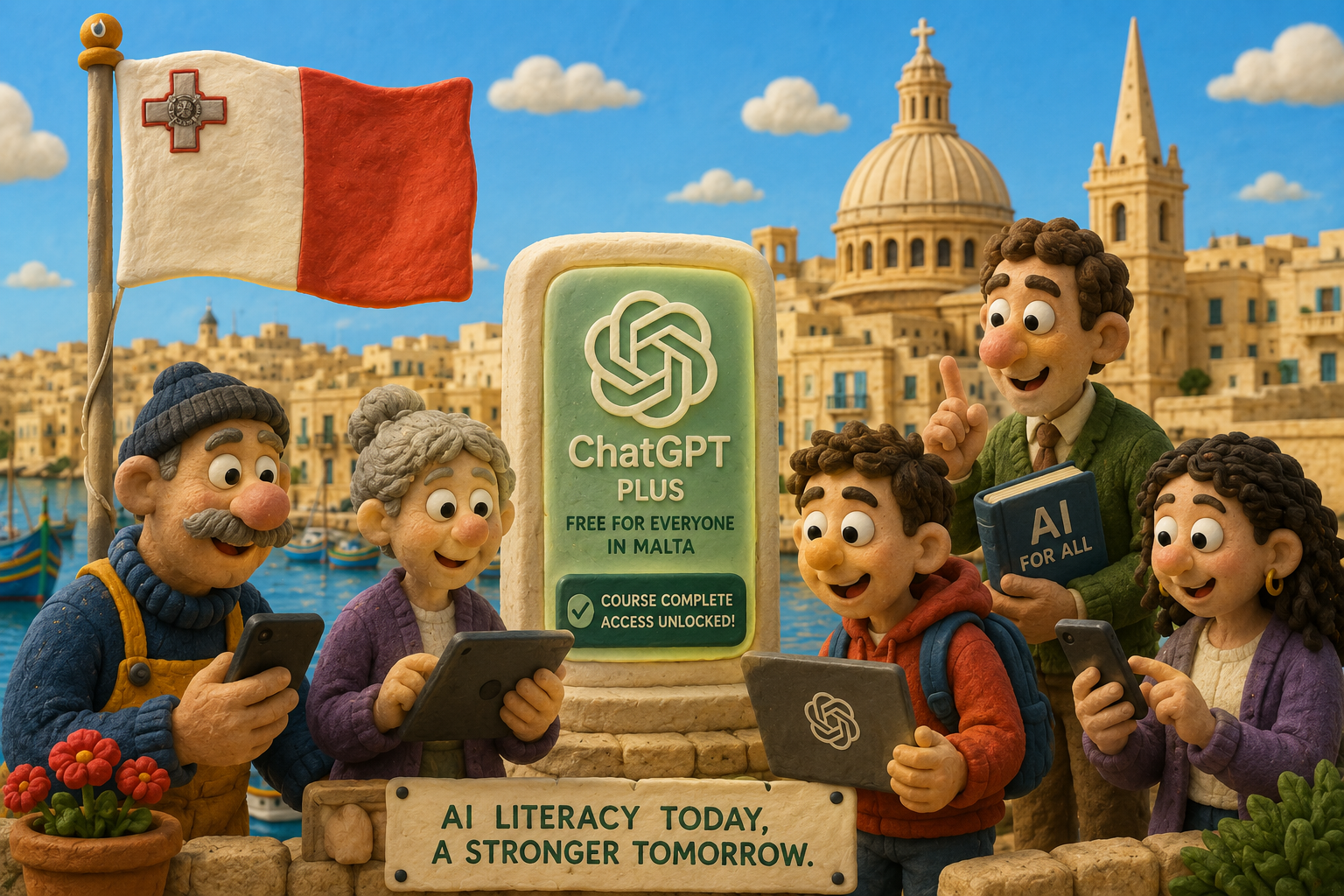
Somewhere in Malta right now, a retired teacher, a fisherman, and a teenager are all about to get the same AI tools that businesses are paying hundreds a year to access. Not because they are tech people. Because their government decided AI should be something everyone gets, not just people who can afford the subscription.
On May 16, 2026, the Government of Malta, OpenAI, and Microsoft announced what they are calling a world first. Every Maltese citizen and resident aged 14 and over will receive free access to ChatGPT or Copilot for a full year. No credit card. No monthly fee. Complete a short course, pick your tool, and it is yours.
I have been watching the government AI space for a while now, and this one feels different. Not because of the free subscription. Because of the thinking behind how they structured it.
What Malta Actually Did
The deal is straightforward on the surface. Malta partnered with both OpenAI and Microsoft under a national programme called AI for All, known in Maltese as AI Għal Kulħadd. Citizens and residents who are registered on Malta’s online identity system can enroll in a free two-hour course called AI for Everyone, developed by the Malta Digital Innovation Authority in partnership with the University of Malta. Once they complete it, they get to choose: a free twelve-month subscription to ChatGPT Plus, or Microsoft 365 Personal with Copilot, at no cost.

That choice matters. This is not a government picking a winner and handing it to everyone. Citizens get to decide which tool fits how they actually work. ChatGPT Plus, which normally costs around $20 a month, or Microsoft 365 Personal with Copilot, which runs between $10 and $39 monthly depending on the plan. Both for free, for a year, just for completing a two-hour course available in Maltese and English at ai4all.gov.mt on any device.
Microsoft’s involvement is not a surprise if you have been paying attention. The Maltese government had already deployed Copilot across its public service, giving 8,000 civil servants access as part of a broader national modernisation push. The citizen-facing programme builds on that existing relationship. OpenAI’s side of the deal fits under its growing OpenAI for Countries initiative, its structured effort to work directly with national governments rather than leaving AI adoption to individual consumers or businesses alone.
The programme is also backed by a €100 million budget Malta set aside for digitalisation in its 2026 national budget, covering AI, cybersecurity, robotics, and emerging technologies more broadly. This is not a one-off experiment with no money behind it.
For the roughly 574,000 people living in Malta, with the offer also extended to Maltese citizens living abroad, this represents something genuinely new: a government treating AI access the way it might treat access to a public library or a national curriculum. Something you are entitled to, as long as you take the time to understand it first.
Why the Literacy Requirement Is the Point
A lot of coverage has focused on the “free ChatGPT” headline. The more interesting story is the course.
Malta is not just handing out subscriptions. They are saying: before you get the tool, you need to understand what it is. That is a meaningful distinction from how most AI adoption has happened so far, which is roughly: release it, let people figure it out, deal with the confusion and misuse later.
When I started using AI tools seriously a couple of years ago, I made plenty of mistakes that a basic literacy course would have saved me from. I asked it to write things it confidently hallucinated. I trusted outputs I should have verified. I did not understand the difference between what the model was good at and what it was just convincingly bad at. That learning curve cost me time and in a couple of cases, real embarrassment.
Malta is trying to shortcut that curve at a national level. Complete the course first, then get the access. The course is self-paced, requires no prior technical knowledge, and covers what AI actually is, what it cannot do, and how to use it responsibly at home and at work. After the foundational modules, participants can also pursue industry-specific tracks aligned with their career and receive an official certificate on completion.
It is a small but genuinely thoughtful design decision.
This Is Part of a Bigger Pattern
Malta is not the only government moving in this direction. OpenAI signed a deal with Greece in September 2025 to bring ChatGPT Edu into secondary schools and launch an AI startup accelerator. Anthropic ran a six-month pilot from late 2025 into early 2026 giving hundreds of teachers across Iceland access to Claude for lesson planning and classroom work. And in the UK, what started as a memorandum of understanding with Anthropic in February 2025 has since produced a real product: a Claude-powered AI assistant live on GOV.UK, actively guiding citizens through employment services and government processes.

The pattern is becoming clear. Governments are no longer watching AI from a distance. They are making active decisions about whether their populations will have access to it and on what terms.
It is worth pausing on that for a second. Because the alternative is not neutral. If governments do not act, access defaults to whoever can afford a subscription or works for a company that provides one. That is not a small gap. For a lot of people, especially in communities with lower average incomes, that gap becomes a skills gap, and then an economic gap, faster than most people expect.
This is exactly what I was thinking about back in November when Albania appointed Diella, the world’s first AI cabinet minister, to oversee public procurement. That experiment has since run into serious legal trouble, with the actress whose image and voice were used to build Diella suing the Albanian government after discovering her likeness had been repurposed beyond the original contract she signed. The contrast between that situation and what Malta has done is instructive. Albania moved fast and symbolic. Malta moved deliberately, with a literacy course designed by a university, a clear consent framework, a choice of tools, and a distribution system built around an existing national identity platform. How you introduce AI to citizens matters just as much as whether you do it. You can read the full Albania story here: Government Just Went Full Sci-Fi: Inside Albania’s AI Minister and Her 83 Digital Children
What This Means for the Rest of Us
Most of us are not Maltese. So the immediate practical question is: what does this mean for you?
A few things worth paying attention to.
First, this is a programme, not a one-off. George Osborne, who leads OpenAI for Countries, said publicly that he hopes other governments follow Malta’s lead. That is not just a polite comment. OpenAI and Microsoft are both actively building the kind of national-level relationships that make these deals possible. If your country has not announced something similar yet, it is probably being discussed.
Second, the literacy component is a template worth watching. If other governments adopt the Malta model, you may see AI access tied to some form of structured learning before long. That is not a bad thing. Understanding what a tool actually does before you use it at scale is how sensible adoption of powerful technology should work.
Third, the dual-tool model is interesting and probably intentional. Offering both ChatGPT Plus and Microsoft Copilot means this is not just a distribution deal for one company. It is a statement about AI becoming general-purpose public infrastructure, the way a government might offer access to both Word and Google Docs in a school system rather than mandating one provider.
FAQ
How can I get free ChatGPT Plus or Microsoft Copilot through my government? Currently, the free AI subscription programme is only available to Maltese citizens and residents aged 14 and over through the Malta AI for All initiative. To access it, you need to be registered on Malta’s online identity system, complete the free two-hour AI for Everyone course at ai4all.gov.mt, and then choose your preferred tool. You can pick either ChatGPT Plus or Microsoft 365 Personal with Copilot for a free twelve-month subscription. The programme launched its first phase in May 2026 and will scale as more residents complete the course. No equivalent national citizen programme has been announced in the UK, US, or Ghana as of this writing.
What is the OpenAI for Countries programme? OpenAI for Countries is OpenAI’s initiative to work directly with national governments on strategic AI adoption. Rather than a single model, it is built around each country’s specific priorities, whether that is education, workforce training, public services, or AI literacy. Malta is the first country to launch a partnership at this scale on the citizen access side, but OpenAI has also been working with governments in Greece, Estonia, and others. The goal, as OpenAI describes it, is to turn intelligence into something closer to a national utility.
What does it mean when a government pays for AI access on behalf of its citizens? It means AI is starting to be treated the way governments treat other foundational services: something the state has a role in making available, not just leaving to the market. The implications run in both directions. On the positive side, it democratises access to tools that genuinely improve productivity, learning, and problem solving. On the other side, it raises questions about which AI providers a government chooses to partner with, what data agreements come with those deals, and who has influence over what citizens are using day to day. These are questions worth following as more governments make similar moves.
The Takeaway
Malta has done something simple and quietly significant. They decided that AI literacy and AI access should go together, offered a real choice between two of the most widely used AI tools in the world, and then built a programme to deliver both. Whether that model spreads to other countries is the question worth watching over the next twelve months.
For governments in Africa and other regions still in the strategy and policy phase, the distance between where they are now and what Malta has just done is significant. Ghana launched its National AI Strategy in April 2026. Kenya published its AI strategy in March 2025. Those are meaningful steps. But a framework document and a working citizen programme are different things, and the gap between them is where most people either get access to the future or do not.
If your government announced a programme like this tomorrow, the real question is not whether you would sign up. It is whether you would be ready to actually use it. That readiness does not come from access. It comes from understanding what you have in front of you.
That is what the course is for. And honestly, it is what a lot of us who got access early still had to figure out the hard way.
If you want to keep tracking how AI is moving at a national and policy level, the best place to follow it is the August Wheel newsletter. I cover these developments as they happen, without the hype. Sign up at newsletter.augustwheel.com.

Leave a Reply