
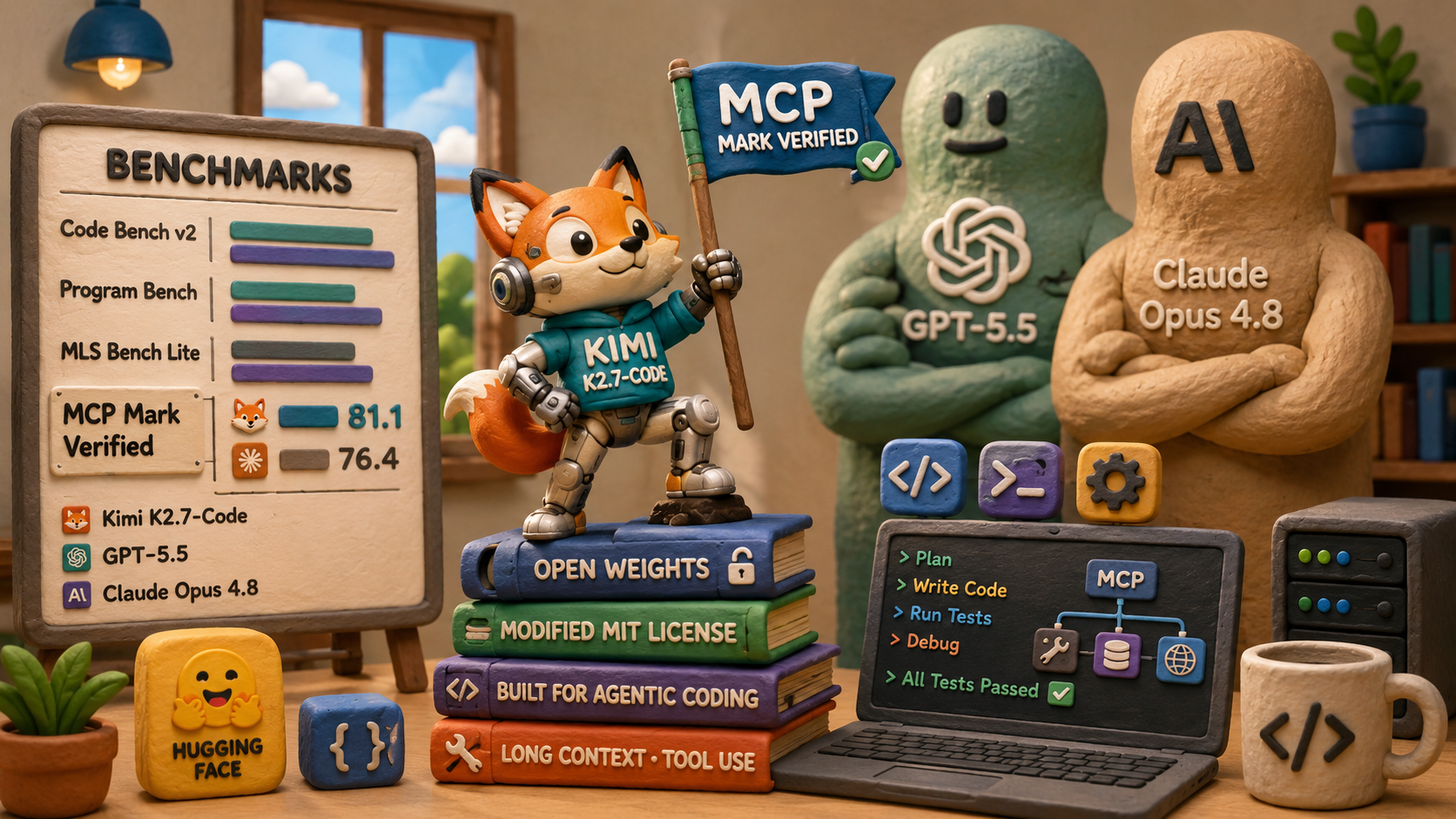
I keep a tab open that just tracks new model releases, and most weeks I close it without much reaction. This week I had to actually stop scrolling. Moonshot AI, the team behind the Kimi models, just shipped Kimi K2.7-Code, and buried in their own benchmark table is a number that beats Claude Opus 4.8.
What happened

On June 12, 2026, Moonshot AI released Kimi K2.7-Code, an open weight coding model. It’s the fifth major release in the K2 family in under a year, following K2 in July 2025, K2 Thinking in November, K2.5 in January, and K2.6 in April. The pace is relentless.
A few things make this release notable. It’s a trillion parameter mixture of experts model with 32 billion active parameters at any time, and it’s built specifically for long agentic coding sessions, the kind where an AI plans, writes, runs, and debugs code across many steps without a human stepping in. The weights are on Hugging Face under a Modified MIT license, which means companies can build commercial products on top of it as long as they give attribution.
Moonshot’s headline claims compared to the previous K2.6 model are a 21.8% gain on Kimi Code Bench v2, an 11.0% improvement on Program Bench, and a 31.5% jump on MLS Bench Lite, along with roughly 30% fewer reasoning tokens burned per task. That last number matters a lot for anyone actually paying for API calls, since reasoning tokens add up fast on long jobs.
How the internet reacted
The initial reaction has been mostly enthusiasm, especially from people already running open source models in production. There’s a real sense that Moonshot is becoming a serious player rather than a curiosity. One detail getting attention is the comparison table Moonshot published against GPT-5.5 and Claude Opus 4.8. On most rows, the bigger labs are still ahead. But on one specific benchmark, MCP Mark Verified, which tests how well a model handles tool calls through the Model Context Protocol, K2.7-Code actually edged out Opus 4.8, 81.1 versus 76.4.
That’s the kind of detail that gets screenshotted and shared, and it has been.
The deeper truth
Here’s where it gets more interesting, and more honest. Not everyone is taking the benchmark numbers at face value. VentureBeat reported that practitioners are pushing back on whether the claimed gains actually check out in real world use, which is worth sitting with for a second. Self reported benchmarks from any lab, including the big three, are marketing documents first and technical documents second. A model winning one benchmark row against a flagship competitor is genuinely impressive, but it’s one row out of six, and it’s Moonshot’s own table.
There’s also a meaningful limitation that’s easy to miss in the excitement: this is a coding only release. There’s no general purpose “Kimi K2.7” for chat or everyday tasks, just this specialized agent. And the model doesn’t support a non-thinking mode, so even simple requests get the full reasoning treatment, which can be slower and costlier than it sounds for quick tasks.
What it means
If you’re a developer or someone experimenting with agentic coding tools, K2.7-Code is worth a look, especially since the weights are open and you can self host with vLLM or similar if you have the hardware for a trillion parameter model (most people don’t, to be clear). If you’re using the hosted version through Kimi Code, plans start at $19/month.
For everyone else, the bigger story is the pattern. Open source labs are closing the gap with proprietary frontier models faster than most people expected a year ago, and they’re doing it model release by model release, sometimes a few weeks apart. Whether or not this specific model lives up to its own marketing, that trend is real and it’s worth watching.
FAQ
What is Kimi K2.7-Code? It’s an open weight, coding focused AI model released by Moonshot AI on June 12, 2026. It’s built for long, multi-step coding tasks where an AI agent plans, writes, and debugs code with minimal human input.
Is Kimi K2.7-Code free to use? The model weights are free to download and self host under a Modified MIT license, which allows commercial use with attribution. Using it through Moonshot’s hosted Kimi Code platform starts at $19/month.
Is Kimi K2.7-Code better than Claude or GPT? According to Moonshot’s own benchmarks, GPT-5.5 and Claude Opus 4.8 still lead on most coding benchmarks. K2.7-Code did beat Claude Opus 4.8 on one specific benchmark related to tool use (MCP Mark Verified), but independent testing hasn’t confirmed the broader claims yet.

Leave a Reply