
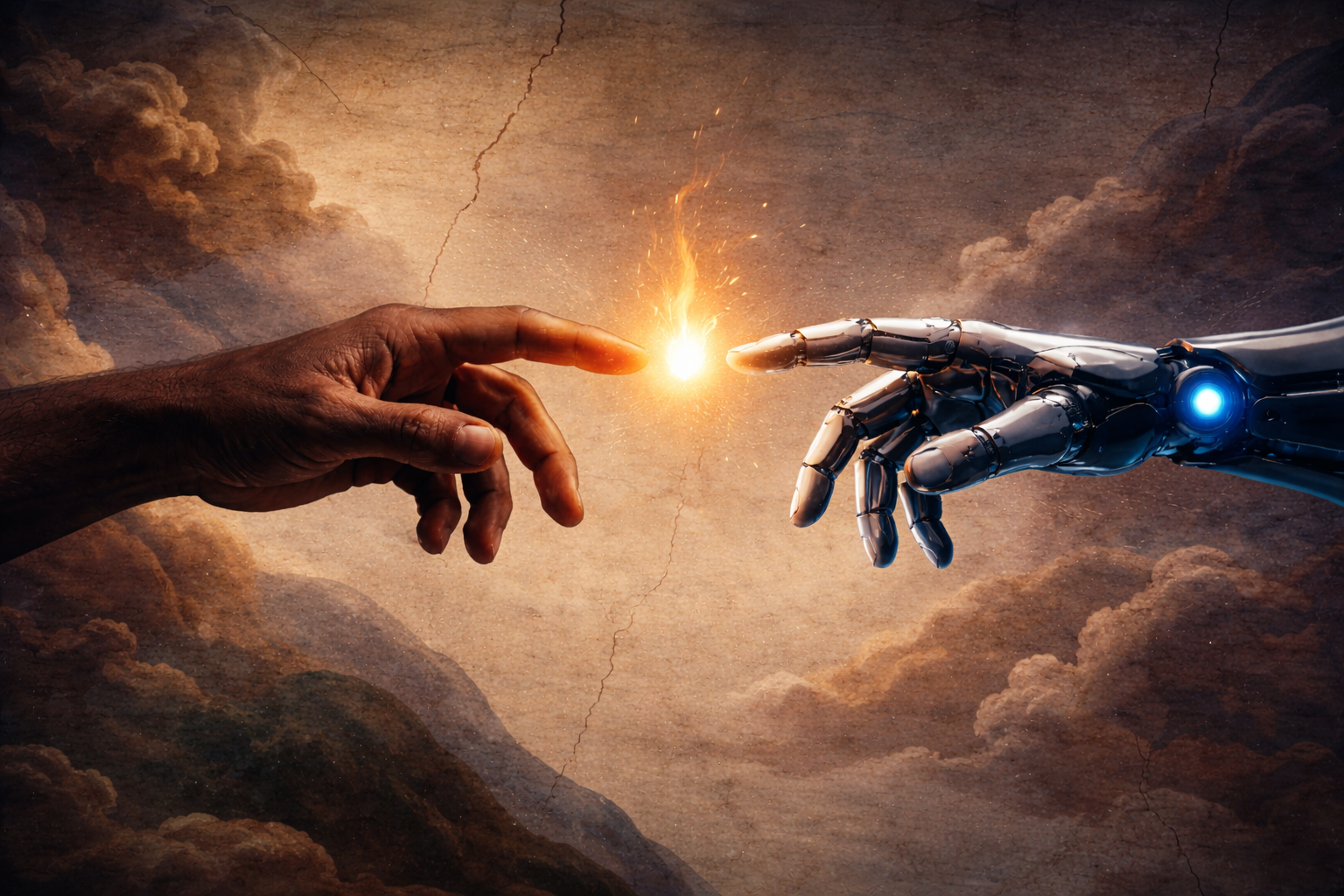
It’s funny how sometimes you wake up and a quote just hits you, not gradually, but all at once. Like the way an apple supposedly hit Newton on the head before he went on to discover gravity. This morning felt similar. Right after my first sip of coffee (Brazilian espresso shot, if you’re wondering), a quote landed square in my mind: “Everything that can be automated will be automated.” I paused. Put the cup down. And sat with it for a moment.
That quote wasn’t written last year. It wasn’t a tweet from some Silicon Valley founder riding the AI hype wave. It was written in 1988 by a Harvard professor named Shoshana Zuboff, before smartphones, before social media, before most people had even touched a computer. She called it a law. Back then, most people called it theory. Now? It’s not coming. It’s here. And depending on who you are and what you do, that feels either exciting or terrifying. Maybe both.
So let’s talk about it honestly. The good, the bad, and the part nobody really wants to say out loud.
The Good: What Automation Actually Unlocks
There is a version of this story that is genuinely wonderful, and it deserves to be told first.
For most of human history, the majority of work has been repetitive, physically exhausting, or mind-numbingly routine. The promise of automation has always been that machines take the drudgery, and humans get to do the things that actually require being human. Creative thinking. Relationship building. Problem solving. Decision making. The stuff that, if we’re being honest, most people would rather spend their time on anyway.
That promise is starting to materialise. Customer service queries that used to sit in inboxes for days now get answered in seconds. Small creators and solo business owners can now operate with the kind of efficiency that once required an entire team. A person with an idea and a laptop can now build, market, launch, and distribute something to a global audience without needing a single employee. That is genuinely new. That is genuinely good.
There is also the access argument. For a long time, powerful tools were locked behind expensive software licenses, technical expertise, and corporate budgets. AI and automation are, slowly but meaningfully, flattening that playing field. The kind of market research that once cost thousands can now be done in an afternoon. The kind of customer communication strategy that once required a marketing agency is now built into tools that cost less than a monthly gym membership. For the first time in a long time, the size of your budget is no longer the ceiling on what you can build.
The Bad: What the Numbers Actually Say

Here is where the conversation gets harder, and where honesty matters more than optimism.
Employee concerns about job loss due to AI have jumped sharply, from 28% in 2024 to 40% in 2026, according to Mercer’s Global Talent Trends 2026 report, which surveyed 12,000 people worldwide. That is not panic without basis. It is a response to things people are actually witnessing in their workplaces and industries.
The corporate moves are real and they are accelerating. Amazon has cut more than 30,000 roles since late 2025, including 16,000 in early 2026 tied to AI-driven restructuring. Salesforce eliminated 4,000 support roles after AI took over half of their customer queries. These are not struggling companies trimming fat. These are profitable organisations replacing people with systems that cost less and scale infinitely.
The jobs most immediately at risk are not always the ones people expect. Of the 37 million workers highly exposed to AI automation, around 6.1 million, primarily in clerical and administrative roles, lack the adaptive capacity to navigate displacement. These are workers with limited savings, narrow skill sets, fewer local opportunities, and in many cases, advanced age working against them. Of those most vulnerable, 86% are women.
These are not high-paying, glamorous roles. These are often the jobs that keep families stable, that support people without university degrees, that have historically provided a reliable entry point into the working world. When those positions shrink, the people who held them do not automatically become prompt engineers.
The future is not going to wait for anyone to feel ready. But you do not need to figure it all out at once.
The Ugly: The Gap Nobody Is Closing Fast Enough
This is the part that sits heaviest, if we’re being candid.
The IMF’s managing director, Kristalina Georgieva, recently described AI as hitting the labour market “like a tsunami,” and warned that most countries and most businesses are simply not prepared for what is coming. That is not a fringe opinion. That is the head of one of the world’s most influential financial institutions standing at Davos and saying, plainly, that we are behind.

The pace at which AI and automation are moving is genuinely without historical precedent. We have been through technological shifts before. The industrial revolution. The rise of personal computers. The internet. Each time, society eventually adapted. New jobs emerged. Education systems adjusted. Policies caught up. But each of those transitions played out over decades, sometimes generations. People had time to retrain, to pass new skills to their children, to reshape institutions gradually.
This time, the pace is different. Entire job categories are not fading slowly. They are compressing quickly. And the infrastructure meant to support people through transitions, retraining programmes, education systems, social safety nets, policy frameworks, is moving at a completely different speed to the technology itself.
By the end of 2026, 20% of organisations are projected to use AI to flatten their hierarchy (link here), potentially eliminating more than half of current middle management positions. Around 40% of enterprise applications are expected to include autonomous AI agents, shifting from systems that assist to systems that execute entire workflows independently. Most people working in those organisations today have received no preparation for what that transition actually looks like on the ground.
That is the ugly part. Not that automation exists. Not even that jobs are changing. But that the gap between how fast the technology is moving and how slowly everything else is responding is widening, and the people who pay the price for that gap are rarely the ones making the decisions.
So Where Does That Leave Us?
I want to be careful not to end this with a tidy bow. There is no single takeaway here that resolves the tension between the genuine opportunity of this moment and the genuine disruption it is causing for real people.
What I do believe is this: the worst position anyone can be in right now is uninformed. Zuboff wrote her law in 1988 because she could see the direction things were heading. Understanding the direction is not the same as being helpless in it. Fear without information tends to paralyse. Fear with information can become something more useful, a reason to pay attention, to adapt early, to ask better questions about what skills actually matter now and what tools are worth learning.
Mercer’s 2026 research found that 62% of employees feel their leaders are underestimating the emotional and psychological impact of AI on the workforce. That gap between what leadership is communicating and what workers are actually feeling is its own problem worth naming. But here is the thing about gaps: they are also where the opportunity lives, for the people who decide to get curious before they get left behind.
The future is not going to wait for anyone to feel ready. But you do not need to figure it all out at once. A good starting point is just knowing which tools are worth your time and how to actually use them without a technical background.
If that is where you are right now, I put together a free AI Quick Start Guide. Six copy-paste prompts that actually work, plus a plain-English breakdown of which tools to use for what. No jargon, no overwhelm. Just a practical first step.
You can grab it below. And also subscribe to venture into the world of Ai with me.


Leave a Reply